
DHDHHDHD
DHDHHHFHF
“Don’t forget to set your scales back 10 lbs at midnight tonight for the holiday season, Thanksgiving through Christmas.”
FHFHFHHF
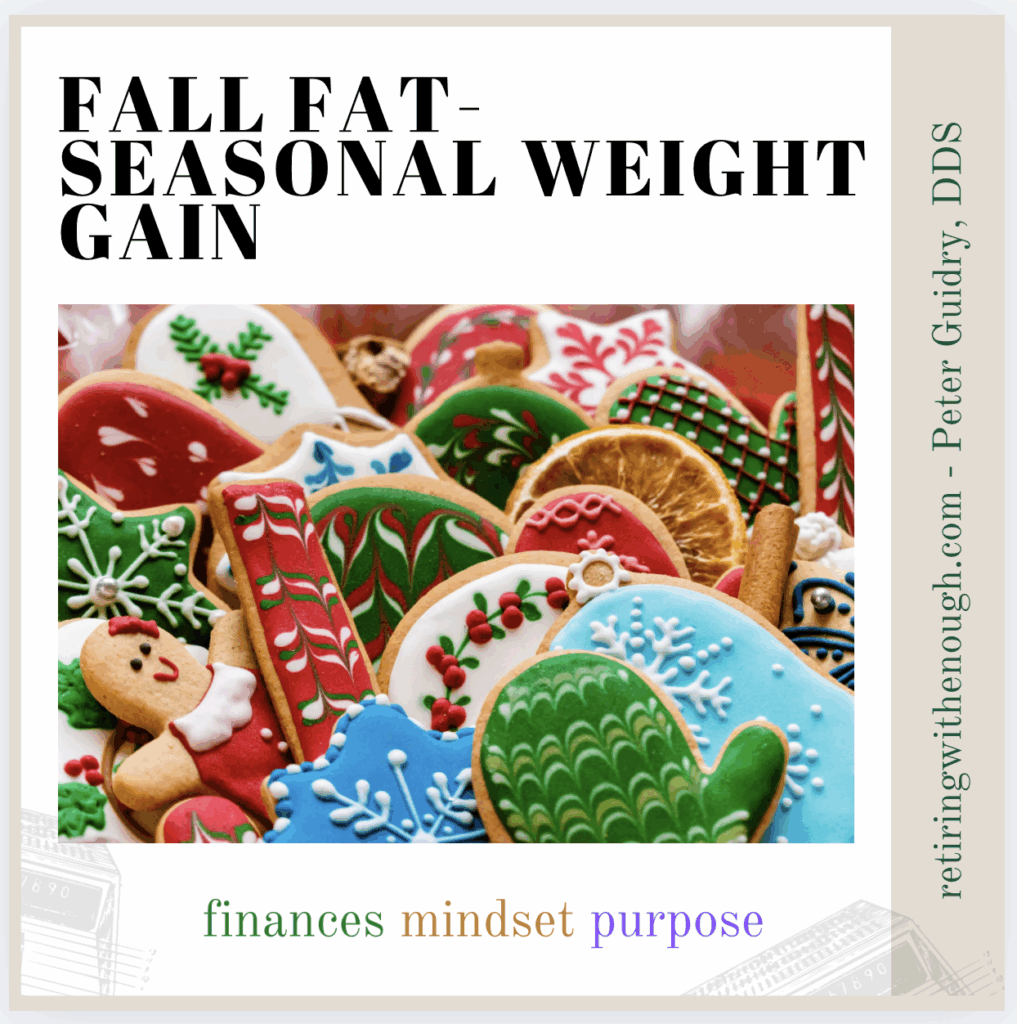
“The best way to prepare for holiday weight gain is to start by eating all of your kids’ Halloween candy. Next up, Turkey and Christmas cookies.”
FHFHHFH
FNFHHHFHF
I love the holidays!………….. and, I hate the holidays!
For better or worse, the holiday season is upon us again. It is arguably the best season of the year. It is also the season of each year that I gain the most weight.
ghhghhghg
What are the reasons for this seasonal weight gain, and is there a reasonable and workable solution?
The reason I want to explore reasonable and workable solutions is that there are numerous solutions, but only a few that are reasonable or workable.
First, let me provide a personal theory on Fall weight gain. As much as we think we are a highly evolved species, factually we are still humans and are subject to the genetic foibles of our ancient ancestors.
Our ancestors lived during a period when Natural Selection favored those who could locate food, consume the most calories in the shortest time, and maintain a minimum weight.
What is the theory of Natural Selection?
Natural selection is the process by which organisms with traits better suited to their environment are more likely to survive and reproduce, passing those advantageous traits to their offspring. Over generations, this leads to a population becoming better adapted to its environment.
- Survival of the Fittest: Organisms that are better “fitted” to their surroundings—for example, with better camouflage or a more efficient way to find food—will have a higher chance of surviving.
- Reproduction: Surviving individuals are more likely to reproduce and pass on their beneficial traits to the next generation.
- Adaptation: This process repeats over many generations. Individuals with advantageous traits have a better chance of survival and become more prevalent. Advantageous traits allow for more gradual environmental adaptations and changes.
fnhvhhhvh
How Does Natural Selection Fit Into my Theory?
*There were few acceptable ways to preserve food, so most food was consumed quickly before it spoiled.
*Winter months meant less available food, so humans who were able to build fat reserves were at an advantage when little or no food was available and humans relied on stored fat to survive the lean winter season.
*Those who found the most food, built the greatest fat reserves, and lost the least amount of weight were favored, and had the greatest chance of survival until springtime.
fhhfhfh
Fast forward approximately 30,000 years and here we are today. Intellectually, we are vastly superior to our ancestors of 30,000 years ago.
Genetically, we are still very similar.
Our bodies still recognize the change in the seasons.
The onset of the winter season triggers ancient biological processes. These ancient biological processes are still encoded in our genetic makeup, and trigger increased appetite, efficient weight gain, and the ability to store maximum fat.
Our bodies aren’t aware that there is a fast food restaurant on almost every corner. This means food procurement is not a problem. Most humans have access to more food and a more varied diet.
Genetic predisposition dictates that we should consume food highest in calories and fat. Our bodies crave these things because genetically we are programmed to gain and maintain as much weight as possible.
So my theory is even though we are vastly superior intellectually, genetically we are still closely related to our ancient ancestors and our bodies need to pack on and maintain as much weight as possible.
Trying to lose weight, or even maintain our current weight as the days get shorter and colder means that we must overcome our body’s genetic predisposition to weight gain and maintenance.
In other words, during the winter months, we are “swimming upstream” when it comes to trying to maintain a healthy weight.
Natural Selection has predisposed humans to maintain as much weight as possible. Our ancient ancestors ate inconsistently and were not always able to find food. Ancient humans whose bodies processed and stored fat most efficiently were at an advantage.
cgcbghghhd
What Happens in the Fall?
In my mind, the fall is the perfect storm where bad behavior combines with genetic predisposition to cause the most harm to those trying to maintain weight and health.
*Increased Calorie Intake: Fall brings an abundance of calorie-rich foods, such as cakes, Christmas candy, pumpkin pie, soups, and holiday meals. Our bodies seem to crave these high-calorie foods that will add the most fat during the winter months. Research indicates most people gain between one and seven pounds during the fall and winter months.
*Evolutionary and hormonal factors: Fall and Winter months bring about hormonal changes. The levels of ghrelin and leptin decrease during the fall and winter months. These hormones play a fundamental role in hunger satiation and cravings. Hormonal decreases result in increased hunger and cravings. This leads us to want more of high-calorie, low-nutrition foods.
*Metabolic slowdown: researchers indicated that metabolism may slow down slightly in the fall and winter which can accelerate weight gain.
*Changes in eating habits: The holidays bring an increase in celebrations and parties where people often overindulge in unhealthy foods and drinks.
*Environmental factors: Cooler temperatures and shorter days create less desire to venture outside. During the winter months, people tend to venture outside less and exercise less. Greater access to high-calorie foods and more time inside create the ideal conditions for weight gain.
*Changes in clothing: People tend to wear heavier and baggier clothing during the cooler months. Looser clothing makes it easier to conceal extra pounds. Looser clothing also means people don’t feel their clothes getting tighter as waist sizes expand.
*Increased consumption of high-calorie drinks: the holidays bring an increased consumption of high-calorie beverages. This includes both alcoholic and non-alcoholic drinks. Many of these drinks fail to reduce hunger cravings and have increased sugar levels, which can increase hunger and cravings.
*Increased stress levels: It has been shown that the holidays also bring an increase in stress for many people. The need to buy the perfect gifts and unrealistic holiday expectations can quickly lead to increased stress levels. For many, these increased stress levels can lead to emotional eating.
*Medical conditions: Certain medical conditions or medications may contribute to weight gain in the fall.
jgjgjjgj
Tips for Preventing Fall Weight Gain:
- Focus on eating less processed foods. Focus on the fruit and vegetable trays at parties instead of the cake and cookie trays.
- Limit sugary drinks and processed snacks.
- Engage in regular physical activity. Explore indoor options for exercise such as a gym membership, or indoor exercise classes.
- Acknowledge and manage stress. Things like exercise, yoga, or meditation can increase self-awareness and reduce stress.
- Get enough sleep.
- Avoid overeating at holiday events.
- Pay attention to portion sizes.
- Consult a healthcare professional if you have any concerns about weight gain or underlying medical conditions.
fhfhhhf
fhfhhhf
Final Thoughts
I love the holidays, just too much! Everything looks and tastes good. The problem is that everything seems to “stick” during the winter months.
Genetically, we’re still similar to our ancestors in the fact that we are predisposed to weight gain in the “lean months” of Fall and Winter. Unfortunately, our Fall and Winter months are anything but lean. This is where the problems start.
I’ve outlined causes and solutions. The solutions are easy. The hard part is in the implementation of these solutions.
Im not saying that people shouldn’t enjoy the holidays, or the accompanying food and family gatherings. Just be aware that all that calorie rich food carries the bad mojo of associated weight gain.
Being aware of the pitfalls of overeating during the Fall and Winter months is the first step in prevention and treatment of Fall weight gain.
FHFHHHFHF
If you’d like to be a part of a free online retirement community, join us on Facebook:

COMMENTS