
HGFHGHGHF
dhgfhghghgfhf
“Curling is nicknamed ‘chess on ice’ because strategy plays just as important a role as skill.” -Brant Curling
“Curling is not a sport. I called my grandmother and told her she could win a gold medal because they have dusting in the Olympics now.” -Charles Barkley
hdhhfhhhf
I have been spending time lately watching the Olympics.
The Olympics, both winter and summer, come every four years. I am attracted less to the Winter Olympics primarily because I live in the southern United States. Living in the deep south means sporadic dustings of snow. Even a dusting of snow is rare.
It’s even more rare for lakes or waterways to experience freezing conditions. Little snow means my affinity with the Winter sports of cross-country skiing, ice-skating, and ice hockey is diminished.
fhfhhfhhf
But, I’ve been seduced by Curling!
hfhhhfhhf
Most Olympic sports are based on speed, power, strength, and ability.
Curling is different. There’s something hauntingly seductive in the extreme slowness and choreography guiding the release of the stones.
As I watched the match, I pondered my attraction to curling. I weirdly realized that curling has many similarities to finance.
hfhhfhhf
What is Curling?
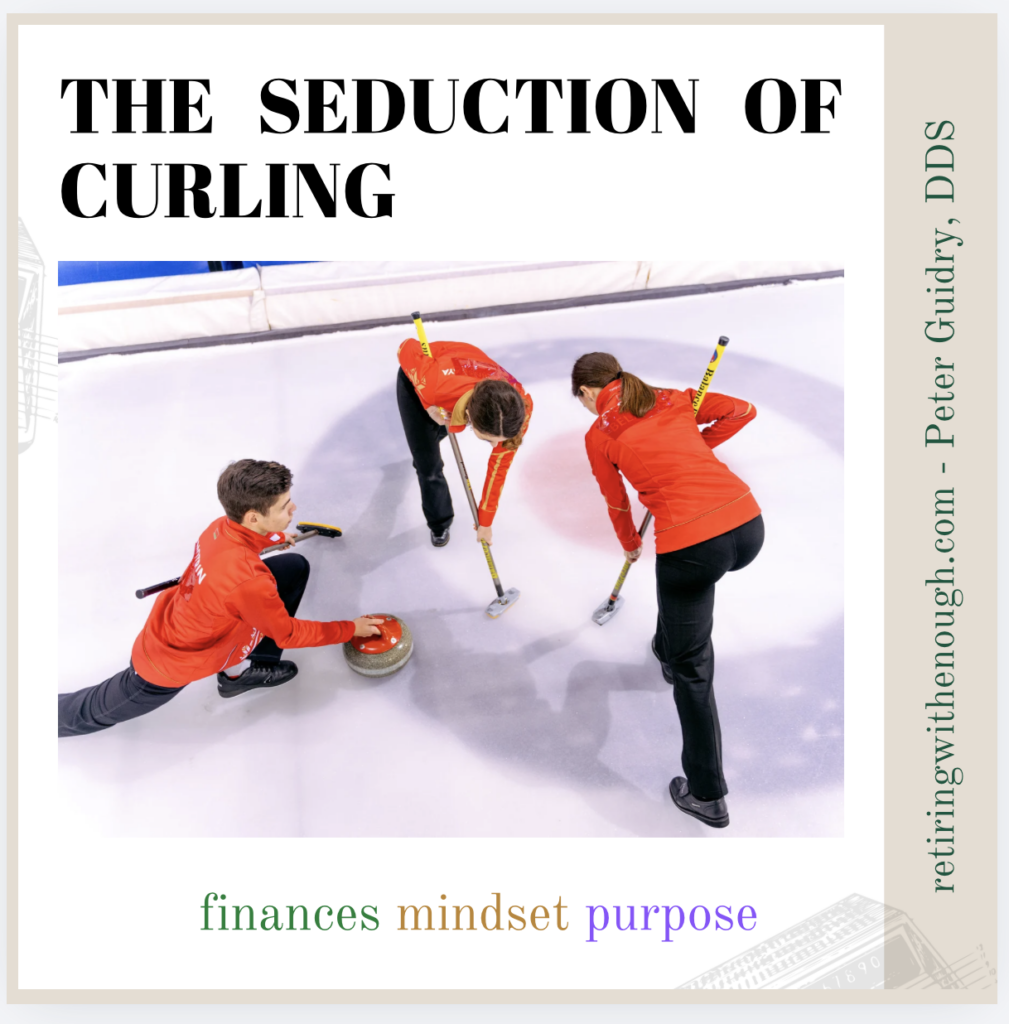
Curling is a strategy-based Winter Olympic team sport played on ice. Players slide 19-kilogram (40-pound) polished granite stones toward a circular target called the “house”. Two teams of four take turns throwing eight stones per round, or “end,” aiming to get their stones closest to the center (the “button”) while using brooms to sweep the ice to influence the stone’s speed and direction.
Key Aspects of Curling:
- Objective: The goal is to have the highest score by placing more stones closer to the center of the house than the opponent.
- The Game Structure: A match typically consists of 8 to 10 “ends” (similar to innings).
- Sweeping: Players sweep the ice with brooms in front of the moving stone to reduce friction, allowing it to travel farther and straighter.
- Terminology:
- House: The 12-foot diameter circular target.
- Button: The center circle of the house.
- Sheet: The 45-meter-long sheet of ice.
- Skip: The team captain who directs strategy.
- Hammer: The last stone thrown in an end, which is a major advantage.
- “Chess on Ice”: Due to the high level of strategy involved in blocking, knocking out, or positioning stones, the sport is often called “chess on ice”.
hfhhhfhhf
Originating in 16th-century Scotland, the sport is known for being social and welcoming, requiring precision rather than high-speed impact.
fnjfjjfjjf
Curling and Finance
First, curling is a team sport. Mixed teams are played with one male and one female, but the more common setup is a team of four players of the same sex. Each team competes as a unit against other teams.
Most people like to think of their financial affairs as being singular. This is not typically true. Most people are part of a team. This team consists of a spouse, employer, children, an accountant, an attorney, and a financial advisor. It’s actually less common for a person to handle their affairs alone.
ghdhhdhhd
The best curling teams are finely honed machines. Each team member has a defined function, and for the team to excel, each member must perform that function. Each team member’s performance must be at the highest level possible. In personal finance, each team member has a defined function. Whether it is breadwinner, spouse, children, family attorney, or family accountant; each team member has a defined function. The financial success of this team will depend on each member functioning at the highest level possible. My family would not be in our current position without the help of my wife, our children, our family attorney, and my lifelong friend and accountant. The success of a curling team is largely dependent on the teamwork of each member!
fjfjjjjf
Curling is based on skill and practice. Olympic Curlers gain the knowledge and skill to compete at the Olympics. This skill and knowledge guide the speed and direction of each stone. Too much speed means the stone will glide past the target zone, and too little speed means the goal will never be reached. It is much the same in finance, as skill and knowledge guide each person‘s financial decisions. Pushing too hard means a person may overshoot their financial goals (think taking too much risk). Not enough effort will mean those goals may never be achieved. Any team that thoughtlessly launches stones won’t remain in competition for long and will eventually lose games to more skilled competitors. The financial outcome of anyone without financial skill and knowledge will be much the same. Even though the comparison is similar, the major difference is that an Investor’s losses can have more serious lifelong consequences.
fjjfjjjfjjf
The game constantly changes. Each game consists of ten Ends, with each End having eight stones played by each team. The team having the last throw of each End has the hammer. Having the last throw is considered to be an advantage. Teams may choose a defensive strategy, an offensive strategy, or choose to “clear the house”, retaining control of the hammer. Younger investors with a longer time horizon are more aggressive. As investors’ time horizon shortens their investment style normally becomes more defensive as there is less time to recover from losses or poor strategy. Investors may also choose to clear the house and totally exit the market. Financially, clearing the house may not be the best strategy. I wrote about this in a blog titled EXPLORING THE OPTION: LIQUIDATING MY STOCK HOLDINGS AND MOVING TO CASH and LIQUIDATING STOCKS AND MOVING TO CASH- PART 2.
fjfjjfajf
As with any Olympic sport, Curling requires a certain amount of strength and agility. But, Curling games are not won with power and quickness. Curling success is dictated by strategy and positioning more than power. Curling is all about controlling the speed, direction, and position of the stone. Financial success results from controlling spending and having a well-thought-out and implemented investment strategy. Financial success results from control of the direction and position of assets.
fhfhhfhf
Most successful investors play the long game. They are not concerned about the Daily noise or the short-term ups and downs of the market. Successful investors focus on winning the game, not on daily market gyrations. Curling team members must consider the match versus the current game. Each regulation game consists of 8 to 10 Ends. An End is completed after each team plays eight stones. It’s easy to get lost in one round, or one play. The match is not won or lost with one stone, or even one End. Players must always keep the match in mind, and not the current stone or End.
fhfhhhf
My financial strategy has changed as my time horizon has decreased. My risk has decreased as my capacity for risk has diminished. Most investors make course corrections. These corrections alter financial strategy over time. Since the game is always evolving, Curling participants must continually alter their strategy as the match progresses. Each game is much like a Chess match played on ice.
hhfhhghhgh
Managing relationships is a big part of the success of finance and Curling. I wrote earlier that most investors are part of a team. Financial success means managing relationships with spouses, children, financial advisors, attorneys, and accountants. A successful Curling strategy includes managing relational strengths and weaknesses. The egos and skills of team members must be woven into relationships so that the team functions as a single unit. In a blog titled SEEKING HAPPINESS: EXPLORING THE CROSS OF LIFE I wrote about the difficulties in balancing the four points on the Cross of Life. I can only imagine how difficult it must be for Olympic athletes to balance training schedules and competition with work obligations, families, and religious beliefs. Is it possible for Olympic athletes to even have a balanced cross? Obviously, I can’t speak from experience on this one! But I do know in the world of non-athletes keeping one’s cross balanced is a difficult and ongoing process.
rhhghhghg
Olympic opening ceremonies include cheerful hopeful faces. Most of the athletes seen in the opening ceremonies will not go home without a medal. They will take home only memories of Olympic competition. In a blog titled MANAGING EXPECTATIONS I spoke about the difficulty and reality of managing expectations and outcomes. Every Olympic athlete trains to be a Gold Medal winner. Does going home without a medal mean those athletes are losers? Are Olympic athletes able to manage expectations to the point where being a part of the Olympic experience makes them winners? In my blog, I spoke about successfully managing financial expectations. Life, whether it involves Olympic competition or financial success, is about successfully managing expectations.
ffhhfhf
fhhfhhfhhf
This blog is being written before the beginning of the women’s curling Olympic semifinal round. Time will tell whether these four women can manage expectations and relationships. Can the USA put together a winning strategy to send them back to America with a medal in Olympic curling?
My seduction and obsession continue as I await the beginning of the women’s Olympic curling semifinal match.
hhghhgh
fnjhjfjjjf
Final Thoughts
Sometimes I wonder if I’ve gone a little bit too far into the weeds with this finance stuff! I can’t even watch a curling match without thinking about comparisons to finance. Should I seek medical help?
Is my obsession with finance worse than my obsession with Curling? The Olympics will be over in a few days, but the blog and podcast will continue!
A current listener commented recently that he thought I was a maniac. I took his statement as a compliment. Now, I am wondering if he was instead speaking about the guy who sees financial comparisons when watching Olympic curling matches.
hhhhgh
fjfjhhjjjjf
If you’d like to be a part of a free online retirement community, join us on Facebook:

COMMENTS