
FHHFHjjhgfhj
ghjghhjgg
“Aftersome” is a term coined by John Koenig from The Dictionary of Obscure Sorrows to describe the feeling of being astonished while looking back on the bizarre sequence of accidents and decisions that brought you to your present life, making it feel both fated and highly unlikely.
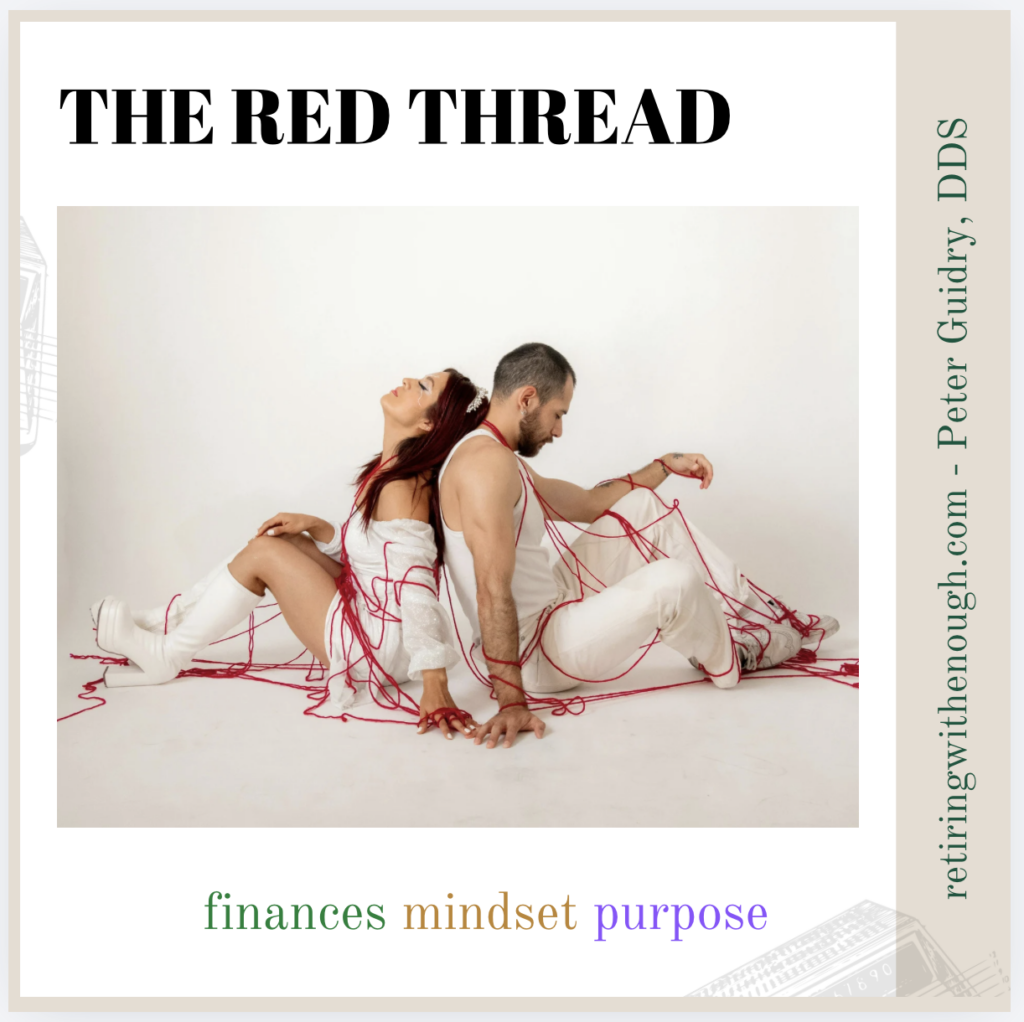
I recently read a story woven around a red thread. The Red Thread is an ancient East Asian belief that an invisible, unbreakable red cord connects those destined to meet, love, or influence each other, regardless of time, place, or circumstances.
Originating from Chinese mythology, this metaphor symbolizes fate, soulmates, and deep, enduring connections.
The East Asian idea of the Red Thread of Fate (often linked to the Chinese legend of Yue Lao, the old man under the moon who ties people together) holds that certain people are destined to meet and remain connected, regardless of time, place, or circumstances.
I was not familiar with The Red Thread philosophy, but I have previously shared my thoughts about relationships and chance meetings in the RETIRING WITH ENOUGH blog and podcast.
I feel strongly that people are put in certain places, exposed to certain individuals, and placed in certain situations for specific reasons. Whether your belief is based on faith, kismet, fate, destiny, or happenstance, there are references to support this supposition.
Similar ideas appear in several other philosophical or cultural traditions.
fhfhhhfh
Here are a few close parallels:
1. Greek Fate and the Thread of Life
In ancient Greek thought, destiny was controlled by the Moirai (the Fates).
• Clotho spun the thread of life
• Lachesis measured it
• Atropos cut it Similarity: Life paths are predetermined and symbolized by a thread, much like the red thread tying destined people together.
2. Hindu Karma and Destiny
In Hindu philosophy, Karma governs how people’s actions influence future events and relationships. Similarity: People may be drawn together because of past-life connections or unfinished karma, echoing the idea that certain encounters are fated.
3. Stoic Fate (Logos and Determinism)
The ancient Stoics believed the universe followed a rational order called Logos. Similarity: Events—including who we meet—unfold according to a pre-existing cosmic plan.
4. Islamic Concept of Divine Decree
Islam teaches that events occur according to Qadar. Similarity: Relationships and life paths can be part of a divinely written destiny.
5. Western Romantic Idea of Soulmates
In Western philosophy and mythology, the idea of Soulmate suggests certain people are destined for one another.
One famous version appears in Plato’s Symposium where humans originally had two halves and spent life searching for their other half. Similarity: The belief that two people are meant to reunite regardless of circumstance.
dhhgfgh
Key idea across all these traditions: Human relationships and life paths may not be entirely random; they may be shaped by fate, cosmic order, karma, or divine intention.
fhghhhg
1. The Greek “Soulmate” Myth
In the Symposium, the philosopher Plato describes a myth told by Aristophanes: • Humans were once whole beings with two faces, four arms, and four legs. • The gods split them into two halves. • Each person spends life searching for their other half.
Why it mirrors the Red Thread: Two people are inevitably drawn back together, no matter how long it takes.
hfhfhhf
2. Norse “Wyrd” and the Threads of Fate
In Norse belief, destiny is woven by the Norns—especially • Urd • Verdandi • Skuld
They weave the fabric of Wyrd, which determines how lives intersect.
Why it mirrors the Red Thread: People’s lives are literally woven together, meaning encounters and relationships are pre-woven into fate.
fhggghfg
3. Jewish Concept of Bashert
In Jewish tradition there is the idea of Bashert, meaning “destined” or “meant to be.” • It is most commonly used for marriage partners. • A person’s destined partner is believed to be determined by God before birth.
Why it mirrors the Red Thread: Two people who are Bashert will eventually meet, even if circumstances delay or complicate the meeting.
dghdhghgd
What makes these nearly identical to the Red Thread concept
Traditions share three core beliefs: 1. Some relationships are predetermined. 2. Distance or obstacles cannot permanently prevent the connection. 3. The meeting is inevitable.
dgdggdg
The Red Thread idea (often linked to the Chinese legend of Yue Lao may be the most romanticized version because it focuses specifically on two individuals tied together, while the others often describe broader fate.
ghhghhg
Sometimes, in quiet moments, I wonder about all the life events that brought me to this particular place and moment in time. Is my past merely a series of random happenings, or is my life’s path the result of a series of coordinated events?
Is my life random, or am I walking a predetermined path created by some greater power? Do I control my own destiny? Or, is my life the result of the intersection of luck and opportunity?
My faith dictates that very few things happen strictly by chance. Does this mean that everything that’s happened in my life can be swept under the rug by saying I’m not really in control?
If for example, I didn’t plan and save during my working career, and my fiscal irresponsibility results in my inability to retire comfortably. Is this fate, or merely the result of poor financial planning? If I instead meet someone who can help me prepare for retirement and teach me about finances, is this fate or luck?
I sometimes think about a song by Garth Brooks titled Unanswered Prayers. The song speaks about a man who meets a former high school sweetheart at a football game and realizes that marrying her would have been a mistake. He thanks God for not granting the request in his nightly prayers. He realized God‘s hand in his unanswered prayers.
It seems as though there is a pandemic belief in fate or destiny. Things happen for a certain reason, and we meet and have relationships with certain people, and these relationships are not random.
For me, this belief flows through faith, for others, it flows through a belief in destiny, or fate. According to the Hindu belief of Karma, this may even extend to unfinished business from previous lives and relationships.
fhfhhhhg
What Does All This Mean?
Does meeting a seat mate on an airline flight mean that you are destined to become lifelong friends? I don’t know about you, but I can’t recall any lifelong friendships established on airline flights. I can say that I’ve had very interesting and meaningful conversations, but the interaction lasted as long as the flight.
Although I do feel strongly that not every person we meet is destined to become part of a deep relationship, I also feel that we must be open to creating friendships. Some of my best friendships resulted from meeting other parents at school events. A shared love of sports develops bonds between sports enthusiasts.
Work environments create opportunities to develop friendships with people of different mindsets sharing the same work.
One of the wonderful things about practicing Dentistry is the opportunity to engage in conversation with a broad spectrum of society. My practice represented different faiths, different work backgrounds, different socioeconomic levels, different political views, and every age from several weeks old to over 100 years old. My staff consisted of women who were older and younger than me!
fghhhg
fhfggfgg
Final Thoughts
Why is it that people meet other people and find it hard to carry on a conversation with one, yet feel like they have known another person for a long time?
What are the dynamics that brought me together with a small group of women and kept us happily working together for several decades?
What truly guides the decisions about who we ultimately marry, where we ultimately live, and who becomes our lifelong friends?
Are there red threads attaching us to others, or is life just a random series of overlapping events?
fhfhhf
ghghhhg
If you’d like to be a part of a free online retirement community, join us on Facebook

COMMENTS